Platform: Sega Dreamcast
Region: Other
Developer(s): Sega
Publishers(s): Sega
ReleaseDate: 1999-09-09
Players: 4
Co-op: Yes
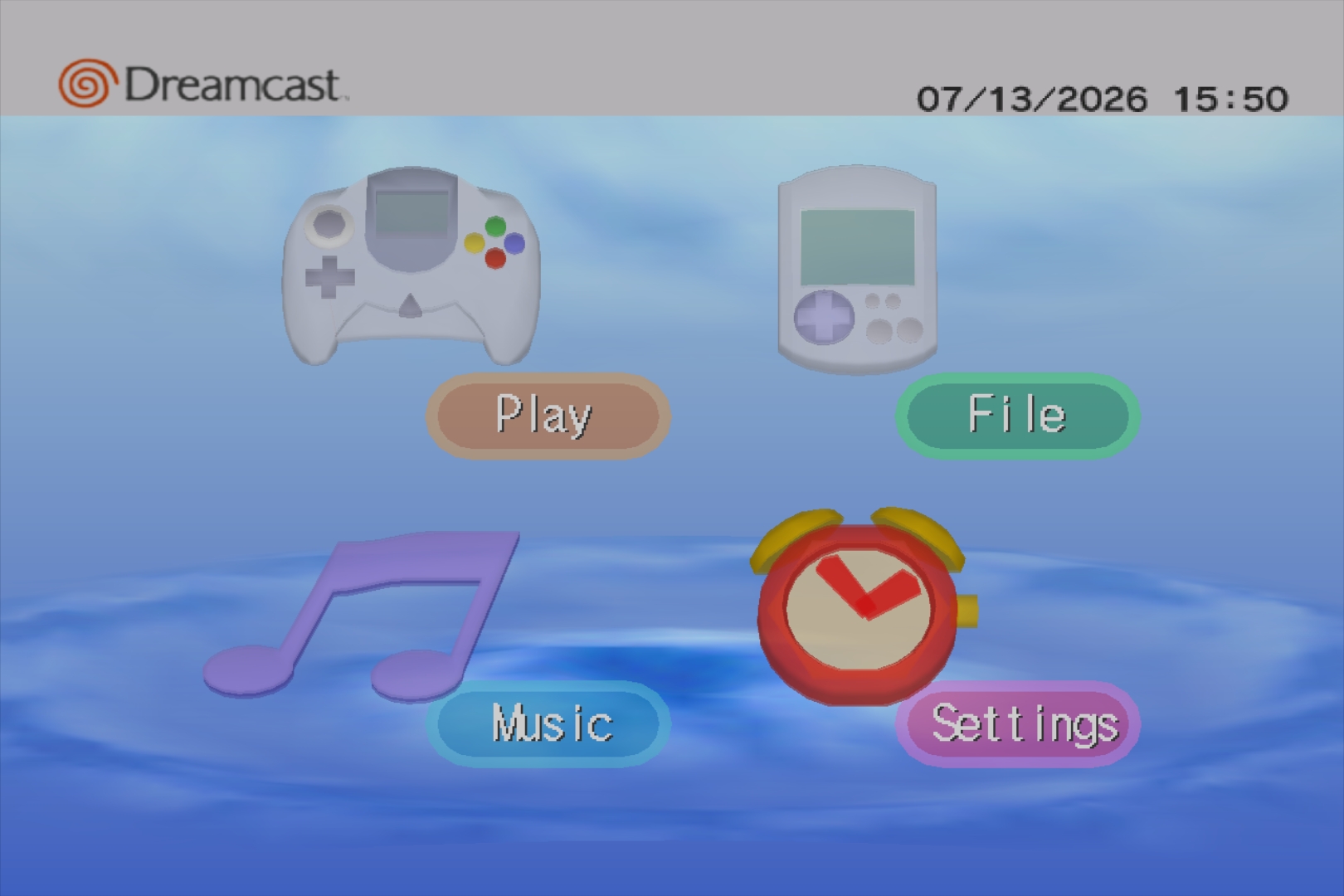
Dreamcast
Also know as: Dreamcast Menu | Dreamcast Bios
The Dreamcast is the final home video game console manufactured by Sega. It was released in Japan on November 27, 1998, and worldwide in late 1999. It succeeded the Sega Saturn and was the first sixth-generation console, preceding Sony's PlayStation 2, Nintendo's GameCube, and Microsoft's Xbox. Manufacturer Sega Type Home video game console Generation Sixth Released JP: November 27, 1998 NA: September 9, 1999 EU: October 14, 1999 AU: November 30, 1999 Introductory price ¥29,000 (equivalent to ¥32,000 in 2024) US$199 (equivalent to $380 in 2025) £200 (equivalent to £380 in 2025) Discontinued WW: March 31, 2001 Units sold 9.13 million Media GD‑ROM, CD‑ROM CPU Hitachi SH-4 @ 200 MHz Memory 16 MB RAM 8 MB video RAM 2 MB audio RAM Removable storage 128 KB VMU Display CompositeRF modulatorSCARTS-videoVGA (via adaptor) Graphics NEC PowerVR2 @ 100 MHz Sound Yamaha AICA @ 67 MHz with ARM7 CPU, 64 channels Connectivity Modem, broadband adapter (separate) Online services Dricas SegaNet Dreamarena Dimensions 195.8 × 190 × 75.5 mm (7.71 × 7.48 × 2.97 in) Weight 1.5 kg (3.3 lb) Best-selling game Sonic Adventure (2.5 million) (list) Predecessor Sega Saturn A team led by Hideki Sato began developing the Dreamcast in 1997. In contrast to the expensive hardware of the unsuccessful Saturn, the Dreamcast was designed to reduce costs with off-the-shelf components, including a Hitachi SH-4 CPU and an NEC PowerVR2 GPU. The Dreamcast shared hardware with Sega's NAOMI system board, enabling authentic arcade game conversions. Sega used the GD-ROM disc format to avoid the expense of DVD licensing. Developers could use a custom version of Windows CE for easier PC game porting. The Dreamcast was the first console to include a built-in modular modem for internet access and online play. Though its Japanese release was beset by supply problems, the Dreamcast had a successful US launch backed by a large marketing campaign. However, sales steadily declined as Sony built anticipation for the PlayStation 2. Dreamcast sales did not meet Sega's expectations, and attempts to renew interest through price cuts caused significant financial losses. After a change in leadership, Sega discontinued the Dreamcast on March 31, 2001, and restructured itself as a third-party developer. 9.13 million Dreamcasts were sold worldwide and over 600 games were produced. Sega subsequently ported many Dreamcast games to other platforms. The Dreamcast's commercial failure has been attributed to several factors, including competition from the PlayStation 2, limited third-party support, and the earlier failures of the 32X and Saturn having tarnished Sega's reputation. In retrospect, reviewers have celebrated the Dreamcast as one of the greatest consoles. It is considered ahead of its time for pioneering concepts such as online play and downloadable content. Many Dreamcast games are regarded as innovative, including Sonic Adventure (1998), Crazy Taxi (1999), Shenmue (1999), Jet Set Radio (2000), and Phantasy Star Online (2000). The Dreamcast remains popular in the video game homebrew community, which has developed private servers to preserve its online functions and unofficial Dreamcast software.
ESRB Rating: Not Rated
Genre(s): Virtual Console